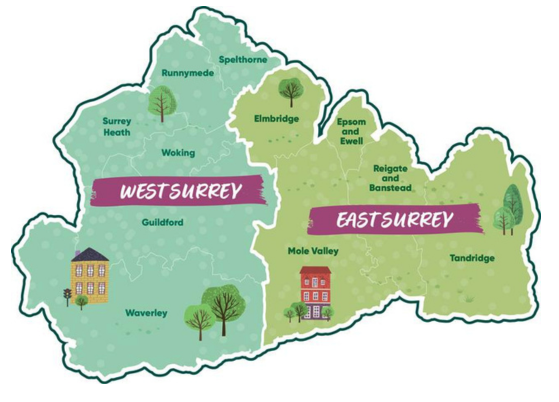
Two New Councils for Surrey

The government has announced a major restructuring of local government in Surrey. By April 2027, all twelve existing councils—including Elmbridge Borough Council and Surrey County Council—will be replaced by two new unitary authorities + East Surrey and West Surrey.

Despite the scale of this change, Surrey residents were not consulted. Surrey County Council’s Conservative leadership chose to pursue the bid regardless, resulting in the undemocratic cancellation of the Surrey County Council elections that were due in May 2025.

Under this model, Elmbridge—and therefore Weybridge—will join a new East Surrey authority alongside Epsom & Ewell, Mole Valley, Reigate & Banstead and Tandridge. One council will manage all services, from planning and waste to highways, education and social care. The aim is to simplify delivery, cut duplication and put services on a more sustainable financial footing.

Independent analysis suggests the two-unitary structure offers stronger financial resilience, especially given the £5.7 billion combined debt across Surrey’s councils. The government has already agreed to write off £500m of Woking’s debt. Larger authorities will also face continued housing pressures, but the wider East Surrey area should offer more flexibility to meet targets while protecting the character of towns like Weybridge and safeguarding the green belt.

Elections for the new councils will take place next May, with the new authorities taking over in April 2027. Elected councillors will serve the first year of their four-year term setting up the interim authority before East Surrey becomes fully operational in April 2027. East Surrey will have 36 wards, each electing two councillors.

Until then, Elmbridge Borough Council and Surrey County Council will continue delivering services. 

Throughout the transition, your Lib Dem team will work to protect local services, uphold Elmbridge’s identity and ensure Weybridge’s voice is heard.

CIL awards in Weybridge

Over Half a Million Pounds for the Community 

This year your local councillors were pleased to be able to allocate £559,370 in Community Infrastructure Levy (CIL) funding to projects across the Weybridge area.

The levy is paid by developers on new building projects. It ensures that development is matched by investment in local facilities and infrastructure. Local organisations can apply for CIL grants to support their capital projects. Importantly, applicants are expected to contribute funding themselves, ensuring that their money leverages greater value from public resources.

Education was one of the largest beneficiaries this year: Cleves School, Walton Leigh School, Oatlands School, St James Primary and Manby Lodge all received funding for a variety of projects.  

Sports and recreation also received strong backing with new facilities planned for Weybridge Vandals, Weybridge Cricket Club, Oatlands Park Bowling Club and Walton & Hersham Youth Football Club. 

Whiteley Village received support for its refurbished clubhouse while Brooklands Museum secured funding to accommodate Brooklands ATC. Girlguiding Weybridge and NW Surrey Synagogue gained funding to improve accessibility and sustainability.

Weybridge Health Campus

The process of replacing the Weybridge ‘Hospital’ which was burnt down in 2017 is still grinding on. Even though the design team had submitted plans to the Local Planning Authority (EBC) in March 2023, delays meant that it wasn’t until the 4th February this year that the Stakeholder Reference Group (SRG) were told that plans were about to be submitted to EBC ready for building to start in the summer of this year: http://weybridgelibdems.org.uk/2024/02/weybridge-hospital-site/

Astonishingly, just over a month later, on the 20th March, we learned that this timescale was put back yet again: NHS Property Services had decided that the Project Leader and his team, who had been working on the proposals for several years, were to be replaced. A new lead company, Wilmott Dixon, was appointed and they insisted on using their own architect to draw up a new design.

It has now taken a further eight months for the SRG to be informed last week that plans were at last ready for a formal planning application to be made. At least there now seems to be money available and the previous problem of a funding gap seems to have been closed. Let’s hope that after seven years of delays, the replacement project will now proceed to some spades in the ground!

Petition for HGV weight limit

With Brooklands becoming a distribution centre for more and more companies, including Amazon, there are now more HGVs travelling through Weybridge and using the Balfour Road mini roundabout to turn into and out of Church Street. This is causing traffic jams, damage to barriers and pavements, and is dangerous to cyclists and pedestrians when the lorries mount the pavements to turn.

Neither Church Street nor the mini roundabout have been designed for this type of traffic and there have been 2 incidents with fatalities in the last 5 years on Balfour Road.

A petition to Surrey County Council was submitted in autumn 2022 to try to stop HGVs coming through Weybridge on the A317, received 270 signatures but was rejected on the grounds that it is a Surrey Priority One network with the comment that there “are no plans at this time to introduce a weight restriction.”

However, undeterred and seeing the escalation of the problem, we have joined with our St George’s ward councillor colleagues to promote a petition to introduce an 18 ton HGV weight limit on Brooklands Road. This is a B road and, if implemented, would achieve the aim of banning HGVs over 18 tonnes from using Heath Road to and from the town centre. There is still time to support the petition through this link or use the QR code below:  https://mycouncil.surreycc.gov.uk/mgEPetitionDisplay.aspx?ID=541 

The petition is due to close on the 29th December.

Large numbers enjoy expanded Weybridge Festival

2023 was the year of our new King and for Weybridge, a new festival. The week long programme started with a dinner catered and served by Brooklands College students and finished with the Community Fair on the 24th June. An exhibition by local artists, photographers and sculptors spanned the halls and walls of the library and Oatlands Park Hotel; concerts and plays, restaurant and cafe lunches and dinners, literary and art talks and a quiz, were enjoyed by many all over the town.

Over one hundred stalls, two stages hosting local choirs and soloists, a beer tent run by Weybridge Vandals and the best cream teas hosted by the Soroptimists and the local Ukrainian population in the Community Centre, all came together at the Community Fair based on Churchfields Recreation ground.

Councillor Judy Sarsby, who worked with the Weybridge Society to organise the Festival, said “an estimated 8000 attended these events and to see churches, schools, sports clubs and local organisations supporting each other was truly inspiring. We are very lucky to live in such a giving community.”

River Thames Scheme animation

The River Thames Scheme (RTS) has produced a new animation to provide a straightforward summary of how the project will protect against flooding.

Entitled “How a Flood Channel Works” the video explains how the proposed new river channel and associated weir improvements will work by making the comparison with a road bypass and junction upgrades.

The RTS covers an area from Egham in Surrey to Teddington in Greater London and includes a new flood channel, built in two sections, that will reduce the risk of flooding to homes, businesses and infrastructure. The easterly section will meet the Thames opposite Elmbridge Canoe Club in Weybridge.

The scheme will also provide habitat for wildlife and a new feature in the landscape for recreation, including on Desborough Island. Footpaths and cycleways will run along the channel and through the new public spaces, linking different landscape elements with communities and providing better connections within and across the area.

The project is being delivered in partnership between the Environment Agency and Surrey County Council.

Find out more about the River Thames Scheme.

Council grants awarded to local organisations

Your local councillors participated in one of the more pleasurable parts of the job in June and July, that of deciding how to allocate money to organisations that had applied for ‘CIL’ money. Every new development is liable to pay a small proportion of the costs as a Community Infrastructure Levy (CIL) to the council to mitigate the effects of the development on local infrastructure. The sums totalled over a year are allocated only to the local area, in our case Weybridge Riverside, St George’s Hill and Oatlands and Burwood Park wards via the Local Spending Board made up of all the ward councillors.

Councillors were pleased to be able to support the following projects in Weybridge:

  1. St James’ Church ‘Access to All’ to finish installing a ramp, an automated new ramp and kitchenette;
  2. Elmbridge Canoe Club for a balcony extension to provide an outdoor land-based training space;
  3. Manby Lodge to refurbish and extend a garage on site to provide an additional activity space;
  4. St James’ School to improve an under-used outdoor space as the first phase of a mindfulness garden;
  5. Weybridge Town Business Group for installing three totems in key spots along the High Street;
  6. Weybridge Vandals rugby, cricket and netball club to provide two female changing facilities.

Haines Bridge

 How can Haines Bridge be made safer for pedestrians?

It has been observed that Haines Bridge, which carries the Queen’s Road over the railway, puts pedestrians at risk since the bridge is so narrow. This leads to restricted width lanes for vehicles and thin strips of pavements. Queen’s Road is a busy main road and, if pedestrians coming from different directions have to cross on the pavements, it makes it very challenging for people to pass; this is particularly difficult for people with child buggies. 

A local resident also pointed out that the parapets are below regulation height. Ashley investigated and asked Network Rail to ensure that parapet alterations would be in the coming year’s budget. They have now informed us that they plan to install caging over the pavements. 

However, we have suggested that a longer-term solution of a new parallel pedestrian bridge should be investigated. While it is acknowledged that this would be expensive, this would make it safer for pedestrians and without widening the bridge itself. 

Here are a couple of examples that have been implemented elsewhere and could be used for inspiration.

1. A bridge in Florida: 
2. The Clifton Suspension Bridge: