Supporting our young people’s mental health

Elmbridge Mayor Tony Popham’s chosen charity this year provided many Weybridge sports clubs with the opportunity to show support and solidarity for young people struggling with depression and mental health problems, following the two lockdowns. 

Cllr Judy Sarsby had the idea to organise a sponsored “Row, Paddle, Run” event to raise money for the Grace Dear Charity. It was attended by Graham & Hope Dear, the father and sister who founded the charity after Grace tragically took her own life after a long struggle with mental health in 2017. Over a hundred local athletes, including members of rowing, kayaking, rugby, netball, cricket, tennis and running clubs participated in the event.

It raised over £6000 and has already enabled the running of two mental health first aid workshops to help educate coaches and welfare officers of local sports and social clubs. More are planned in 2022. These aim to aid recognition of the signs and symptoms of mental health illness, how to approach those struggling and provide them with support.

The first of these was held at Elmbridge Canoe Club and was attended by Lib Dem Councillors Judy Sarsby and Jez Langham of Long Ditton. Judy and Jez plan to run a series of these workshops to help create a web of mental health support across the Borough using sports and social clubs. “A young person struggling may not go to their parents or the school for help, but many have built relationships of trust and friendship with coaches”, says Judy who is also a club welfare officer; “We hope that by educating coaches on what to look for and how to ask the young if they are OK, we can find those who are struggling the most and offer support. We’re not health professional but do have access to a lot of support outlets. This pandemic has hit the young particularly. Many are struggling and not sure where to turn. We’re hoping these workshops will help and have already had done success .” The next workshop is planned for February. If you feel this could be beneficial to you in working with the young, to learn the signs and symptoms, please contact Judy at Jsarsby@elmbridge.gov.uk

Protect our Rivers from Raw Sewage

Our protest against dumping raw sewage

Last week the government rejected a Lords’ amendment to place a legal duty on water companies to reduce raw sewage discharges into rivers. Yet every river in England is polluted beyond legal limits. In England last year, water companies released untreated human waste directly into our waterways over 400,000 times for a total of 3.1 million hours.

Thames Water sewage data show hundreds of illegal spills:
https://on.ft.com/2ZEdJVZ

Can the water companies afford to improve their sewage systems to prevent discharges? This article suggests that they have spent billions on share dividends that could have been used to tackle this problem: cutting sewage spills 

Many people in Weybridge use the Thames to improve their well-being through sport and recreation. Our local MP, Dr Ben Spencer, voted with the government to reject the amendment to clean up our rivers. You can contact him by email to challenge him on his position: ben.spencer.mp@parliament.uk


Town Path Local Inquiry

You will have noticed that the upgrading of the paths around Churchfields was completed in May. Not only were these busy paths widened to 3 metres wherever possible to make them safer for all users but the proposals put forward by Cllr Ashley Tilling (for lighting to be installed on the path between the playground and the allotments, to move the fences to provide a much safer s-bend next to the skate park, and for the route into town through the car park to be made good) were all agreed and implemented.

However, a Local Inquiry is to be held at 1000 on the 7th September (venue to be decided) to determine whether the paths should be shared for both cyclists and pedestrians. Written representations should be made by 10th August to Sarah.tudor@planninginspectorate.gov.uk, using the same address to register intentions to attend the inquiry.

To download the details of the Inquiry click on this link: Pre Inquiry noteDPIQ36302110 PIM Note 21 07 21

Weybridge and Oatlands Paddling Pools

The paddling pools at Oatlands and Churchfields Recreation Grounds are usually open for the school summer holidays. Your local councillors were rather surprised to be informed on the 21st May that the paddling pools in Churchfields and Oatlands Recreation Grounds would not be opening this summer as a result of the covid situation. This was due to an operational decision taken by our officers (the Borough’s civil servants) at the Civic Centre in the middle of the second lockdown when they thought it unlikely that government restrictions would allow sufficient relaxation of social distancing rules to allow the pools to be opened safely. At the request of councillors, a meeting with officers took place on Friday 28th May to review the position. Your councillors explained that the well-being of children was particularly important after more than a year of unusual and difficult circumstances for many families. It was therefore agreed that the position would be reviewed and that a schedule and cost for the necessary maintenance and water testing should be put in place to allow for the pools to open as usual.  

Desborough Island

Our campaign to tidy up Desborough Island

As a keen rower with Weybridge Rowing Club, Weybridge Riverside candidate, Judy Sarsby, has noticed the increasing amount of rubbish being casually strewn around Desborough Island, some of it from fly-tippers. And so she set about forming an enthusiastic group of volunteers who meet every week to tidy up this lovely Weybridge open space. Everyone is welcome to join by getting in touch with Judy.

As summer begins and lockdown recedes, families, sports enthusiasts, walkers and picnickers venture onto the island to enjoy the peace and quiet, the fresh air and the flora and fauna. It appears that the example set by the litter-pickers has encouraged others to take their rubbish home, or at least to the bins at the entry to the island. On recent outings much less litter has been found on the green spaces, though there is still some fly-tipping.

Surrey County Council have recently announced that they will continue to help with funding of the Environment Agency’s scheme for a lower Thames flood relief channel from Staines to Shepperton. An exciting part of the plans include the formation of a wetland habitat on Desborough Island and improvements to access through forming an interconnected route along the channel for walkers and cyclists. 

We would welcome your ideas on the future of Desborough Island via our comments section below.


The Missing Link

As soon as Cllr Ashley Tilling became involved in discussions about the Brooklands Accessibility Project a couple of years ago, it seemed to him that a key option for linking Brooklands to the town centre was missing.

The Accessibility Project has already brought a much safer route for people on foot or bike making journeys to or via the station; it provides a properly surfaced and illuminated track from Brooklands to the station, the shared path along Heath Road and the improvements to the town paths. However, it has a big limitation in that all users have a severe restriction at the railway bridge where cyclists will have to dismount in order to safely pass pedestrians on the narrow pavement over the bridge. 

With the renewed interest in cycling and walking that the pandemic has presented, as well as the additional encouragement to leave cars at home, it seemed that there was an opportunity to investigate a ‘missing link’ route. This would make use of the closed railway bridge which was built to connect Locke King House (now Brooklands College) to the Brooklands race track. The path would open up an additional traffic-free route for all those travelling to and from Brooklands and the Locke King housing area with Brooklands College, Heathside School and the town centre without having to negotiate the narrow pavement on the road bridge. 

Ashley contacted Network Rail last year to ask if there was a possibility for them to give permission to use the railway bridge. Their recent reply is very encouraging. They have now conducted a paper-work investigation and physical structural check of the state of the bridge in question. This is their response:

The bridge in question is currently in reasonable condition and, subject to the relevant processes, we would in principle be in a position to transfer it to the local authority if they wished to dedicate public rights over it. 

He will now pursue this scheme with Surrey and Elmbridge Councils but your support for this would be most welcome. Please tell us what you think of this idea and whether you might use this bridge (you can use our comments section).


River Thames

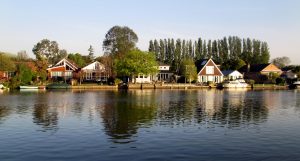
The River Thames is a popular location for Weybridge residents to participate in many different types of recreation.  In this joint blog article Pete Hampson describes what the River Thames has meant for him over this past year and then Judy Sarsby reports on recent developments on unauthorised moorings. 

Pete Hampson writes: 
“Sitting at the confluence of the Wey and the Thames, Weybridge affords its residents some lovely surroundings, a fact that was brought home to me this year as lockdowns and other restrictions limited where we could go and what we were able to do.  

As a cyclist and keen walker, I can regularly be found making my way along one of our rivers and, in the case of the Thames, rowing along on it.  Since March I’ve been working from home and during the first lockdown my daily exercise often took me cycling along the Thames path.  In May we rowers were allowed back onto the river, socially distanced single sculling being the order of the day – single sculling closer than 2 metres to another boat generally provides a more immediate concern than potential COVID spread.  

In the absence of the normal water-traffic, nature had taken full command of the river, and when non-motorised craft were allowed to venture back we returned to an ornithologists dream with a great abundance of young bird life to be found: amongst the usual coots, mallards, moorhens, swans and geese, there were grebes, herons and even kingfishers to be spotted. 

Over the course of the summer, recreational river use flourished; canoeists and paddle boarders were out on the Wey, and in addition to their number on the Thames, we saw skiffs, oar-boards, kayaks, sailing boats, and plenty of swimmers alongside the usual pleasure craft mixing in with us rowers.  Meanwhile along the bank, anglers, walkers, runners and cyclists were making the most of the glorious weather and the wonderful surroundings.  Businesses were popping up, renting out equipment for people to enjoy, and providing classes to those wanting to try something new. And as the pubs re-opened, there were full beer gardens of patrons relaxing by the waters edge.

Now as we come to the end of the year, and endure a further lockdown, I’m again returning to my cycling and walking along the towpaths of our local riverbanks, and am heartened to see the many others who are managing to spend time out and about during these short days. Our rivers bring enormous benefit to us, improving our health, happiness and prosperity, but as with all natural resources they also need our protection.  Ensuring that we can continue to enjoy them for generations to come requires us to not only be aware of the risks they face, but play an active role in their conservation.”

Judy Sarsby adds
I recently interviewed local Olympic rower Pauline Peel (Bird). Please follow this link to view the video: Pauline Peel interview

One of the problems faced by users of the River Thames is the presence of boats mooring permanently on both public and private land without permission.  Councillor Ashley Tilling is a fellow member of Weybridge Rowing Club and of Thames Valley Skiff Club and we have witnessed a significant increase in boats moored without permission along the river.

Many users of the river and local residents have raised a variety of concerns about these vessels. Their visual appearance is often dilapidated, there are questions about how the boats dispose of their general waste and on the Molesey stretch the boat residents have even fenced off areas of the towpath to claim as their own gardens. Towpath walkers have found this intimidating.    

The EA (Environment Agency) is responsible for policing the river and in September this year they told Elmbridge Borough Council that of 148 boats moored on the river only 53 had permission. More than six out of ten boats that the Agency checked had no permission to be on the mooring they were occupying.

The EA moorings are intended to be used free for the first 24 hours and are then chargeable up to a maximum of 72 hours. After the 72 hours the vessel is expected to move on and there is now a no return period of 24 hours. New signs have been erected explaining the charges and advising on how to pay. 

Maintaining an available supply of temporary moorings is very important to allow vessels to make passage, over several days, up and down the River Thames. If all the temporary moorings are blocked by vessels using them permanently then vessels on passage are forced to find an ad hoc unauthorised mooring. In October last year the EA at long last responded to these concerns and engaged an enforcement company to actively check licences and monitor moored boats. There was some success before the latest lockdown and it is hoped that work to move -on vessels moored without authorisation will commence apace over the summer months so that we can better enjoy our wonderful stretch of river.

Volunteering during the lockdowns

An interview with Cllr Ashley Tilling 

Focus: How did you get involved with volunteering during the Covid-19 pandemic?  

When the national call for NHS Volunteers was broadcast in April I put my name forward. But for a couple of weeks I heard nothing. I then​ bumped into a neighbour who was involved in the Surrey First Responder volunteer scheme – organising the collection and delivery of medicines to people who were shielding, isolating or too ill to go out. He was very happy for me to join his small team.

Focus: How does the scheme work? 

On Tuesday and Thursday afternoons I received a list of prescriptions requiring to be picked up from pharmacies and to whom they were to be delivered. Some of these were marked urgent, so needed to be collected that afternoon, while others could wait until the following morning. 

Focus: Typically how many people were on your list?

Usually between four and six scattered around Elmbridge. I decided to use the scheme to try to keep fit and so dusted off my road bike. A typical route would be from Weybridge to Hersham, Esher, Claygate, Thames Ditton, Molesey and back via Walton on Thames, collecting and delivering along the way. Between April and July, I had made well over 80 deliveries all over Elmbridge. I was also recently called up again and helped during ‘Lockdown 2’. 

Focus: Have there been any challenges?   

Sometimes I would turn up at a pharmacy to find that they had not received the prescription on my list – it then took some persuasion and co-operation from the pharmacist to sort this out with the issuing GP practices. Finding the location for a delivery could also be a headache – a lucky encounter with a passing postman once helped!

A regular Weybridge recipient comments:

“We are so grateful for our prescriptions being delivered. Both my husband and I have multiple prescriptions, all cheerfully delivered. We have shielded since before the first lockdown and are so looking forward to the vaccination. Thank you to all those who have worked delivering our medicines”.


Desborough Island

The vision I think we should all support is for Desborough Island to be an outdoor, green sports facility that utilises this beautiful Weybridge island to its maximum potential. Outdoor sport can go hand in hand with diverse wildlife, the new proposed Wetlands and enhancing the appeal of the green spaces.

Currently on the island we have rugby, football, cricket and netball. Rowing and canoeing have long been sports enjoyed on the river and, this year, paddle boarding and wild swimming saw a huge increase in participation so that more and different people enjoyed the outdoor sports our river has to offer.

It could be even better. We could have a running path and cycle circuit all around the island and boating facilities for sports people with a disability. If we were to develop the existing area of Vandals and maybe employ a caretaker-come ranger to maintain the facilities and patrol the island, we would have an enviable green outside sport and wildlife island for all local residents to enjoy throughout the year.

We should cherish this beautiful site and look after the wildlife whilst enhancing our outdoor sports facilities for people of all ages and abilities.

Judy Sarsby

Local Boundary Posts

If you’ve seen one of these on Desborough Island or close to Cowey Sale, you may wonder what they are for. They actually date back to the Victorian era and mark the Coal Tax boundary. So anyone bringing coal into the Metropolitan Police District (plus the City of London) would have to pay Coal Tax. The purpose of the posts was to give notice of where the boundary ran so that no-one could claim ignorance of liability to pay the duties.

The 24/25 VICT refers to the years of Queen Victoria’s reign in which the Act requiring the payment of the duty was passed (i.e. 1861-62 session). CAP 42 refers to the relevant chapter of the parliamentary Act. 

In the 1880s the City and the Metropolitan Board of Works wanted the duties to continue in the face of growing opposition from the public and national politicians, but when the MBW was replaced by the London County Council in 1889, the new council declined to support renewal. An act was passed in that year abolishing the duties, the last of which was collected in 1890. The abolition was opposed with some underhand tactics: a parliamentary select committee sitting in 1887 found that signatures on a petition in support of keeping the tax had been forged!

The posts thus represent the final phase of the duties in the face of growing opposition. They had been collected for over 300 years but within 30 years of the posts going up were abolished.

See how many you can spot! There were originally around 280 posts of which around 210 remain.