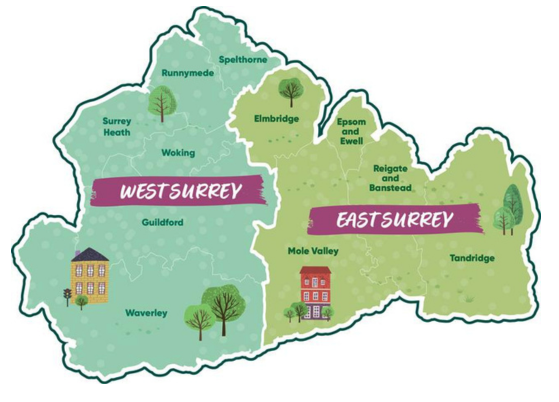
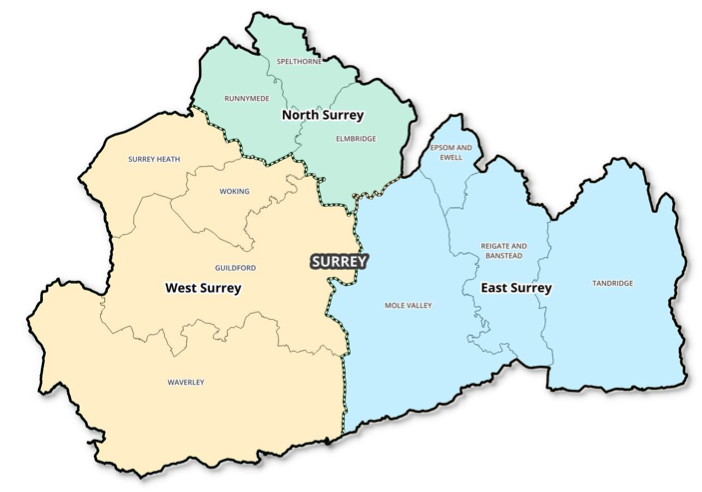
We are approaching a major restructuring of local government in Surrey. By April 2027, all twelve existing councils—including Elmbridge Borough Council and Surrey County Council—will be replaced by two new unitary authorities + East Surrey and West Surrey.
Despite the scale of this change, Surrey residents were not consulted. Surrey County Council’s Conservative leadership chose to pursue the bid regardless, resulting in the undemocratic cancellation of the Surrey County Council elections that were due in May 2025.
Under this model, Elmbridge—and therefore Weybridge—will join a new East Surrey authority alongside Epsom & Ewell, Mole Valley, Reigate & Banstead and Tandridge. One council will manage all services, from planning and waste to highways, education and social care. The aim is to simplify delivery, cut duplication and put services on a more sustainable financial footing.
Independent analysis suggests the two-unitary structure offers stronger financial resilience, especially given the £5.7 billion combined debt across Surrey’s councils. The government has already agreed to write off £500m of Woking’s debt. Larger authorities will also face continued housing pressures, but the wider East Surrey area should offer more flexibility to meet targets while protecting the character of towns like Weybridge and safeguarding the green belt.
Elections for the new councils will take place on 7th May with the new authorities taking over in April 2027. Elected councillors will serve the first year of their four-year term setting up the interim authority before East Surrey becomes fully operational in April 2027. East Surrey will have 36 wards, each electing two councillors.
Until then, Elmbridge Borough Council and Surrey County Council will continue delivering services.
Throughout the transition, your Lib Dem team will work to protect local services, uphold Elmbridge’s identity and ensure Weybridge’s voice is heard.
In December 2024, central government published a paper to set out its approach on devolution – transferring more powers from government to local or regional authorities. They proposed that each area should elect regional Mayors where they don’t currently have them. This approach means that additional power is given to the Mayor, giving them more control over strategic decision making for their area.
To unlock the devolution of further local powers and elect a Mayor, some areas need to reorganise first. This means creating unitary authorities to simplify and streamline local government. Unitary councils are responsible for the services currently delivered by both the county council and local councils. In Surrey, there are eleven district or borough councils, responsible for waste collection, planning, cemeteries, parks and recreation grounds, and Surrey County Council responsible for Children’s Services, Adult Social Care and highways. LGR would mean dissolving all of the existing councils and combining services into unitary authorities. Having fewer councils creates efficiency, clarifies service delivery and saves money. It is, though, debatable whether this is ‘devolution’, which surely entails giving responsibility for democratic decision-making to the most appropriate local level.
The effect of being in the first wave
The Tory-led SCC administration volunteered to be in the first wave of devolution knowing that this would mean the cancellation of the county elections due to be held in May 2025 and extending the term of office of current councillors by two years without a further election. It has also meant that there has been very little time to thoroughly explore all the options for the configuration of the new unitaries, how the debt of councils will be managed and the complexities and costs of organising new teams to handle the key areas of Children’s and Adult Social Services.
Final plans submitted to government
A six week public consultation finished on the 5th August. Congratulations if you waded through the dense, opaque language in the numerous questions better suited to officers working in local government rather than members of the public.
Three unitary proposals
Nine of the eleven local councils are promoting a grouping of current councils into three new unitary authorities. They argue:
Our proposal offers local government that is built around Surrey’s distinct and recognised functional human and economic geographies. By aligning local government with well-defined and understood places, we can create a system that is more responsive, effective and attuned to the diverse needs of the people, communities and businesses that call Surrey home.
Put simply, we believe that local authorities with administrative boundaries that reflect functional and locally recognised areas are better equipped to meet the needs of these areas. They will also improve the potential for partnership working across the system and with community partners.
Two unitary proposals
Surrey County Council, Elmbridge and Mole Valley have promoted a final plan to government splitting Surrey into two councils, East and West. They say:
We’ve analysed a wide range of data on how the two councils would operate and our approach is supported by many of Surrey’s key public sector organisations including health, police, fire, business and community leaders. Existing county council services across Surrey are proven by independent inspectors to be strong, with successful outcomes for residents, and Surrey County Council and many of the district and borough councils have stable finances. This puts us in a good position to see Surrey through reorganisation smoothly.
What next?
The government is now considering the proposals and will make their decision know by the end of September or October. It is rather worrying that in the rush to provide lengthy proposals, key aspects such as how many councillors will represent each ‘division’ (‘wards’ will disappear) have not yet been put forward.
The process of replacing the Weybridge ‘Hospital’ which was burnt down in 2017 is still grinding on. Even though the design team had submitted plans to the Local Planning Authority (EBC) in March 2023, delays meant that it wasn’t until the 4th February this year that the Stakeholder Reference Group (SRG) were told that plans were about to be submitted to EBC ready for building to start in the summer of this year: http://weybridgelibdems.org.uk/2024/02/weybridge-hospital-site/
Astonishingly, just over a month later, on the 20th March, we learned that this timescale was put back yet again: NHS Property Services had decided that the Project Leader and his team, who had been working on the proposals for several years, were to be replaced. A new lead company, Wilmott Dixon, was appointed and they insisted on using their own architect to draw up a new design.
It has now taken a further eight months for the SRG to be informed last week that plans were at last ready for a formal planning application to be made. At least there now seems to be money available and the previous problem of a funding gap seems to have been closed. Let’s hope that after seven years of delays, the replacement project will now proceed to some spades in the ground!
Weybridge Transport Strategy: £5 million for Weybridge’s streets
A public consultation took place early last year on plans to improve the streets in Weybridge town centre to make them safer for pedestrians and cyclists and to improve traffic flow at some junctions. The total cost of these improvements comes to £5 million with money coming from SCC and EBC’s Strategic CIL (Community Infrastructure Levy) fund. As a result of the consultations, the proposals to close Elgin Road and Old Wharf Way to traffic were removed.
Due to the M25 junction 10 programme, which should finish by the end of this year, the programme has been divided into two phases. Phase 1 works will be less interfering to traffic and will be co-ordinated with National Highways to limit the effect of any J10 restrictions or closures. Phase 2 works will have a more significant effect on traffic flow and will be scheduled for early next year.
We understand that Phase 1 works will include:
Pavement and cycle lane improvements on the High Street between Elmgrove Road and Baker Street; 25/04/24, 1 day;
Improvements to Monument Hill/Baker Street priority junction; 23/04/24, 2 days;
Work on the Bridge Road/Old Wharf Way junction; 12/02/24, 20 days;
Installing a Manby Lodge School crossing (scheduled during the August school holidays).
Phase 2 plans include improvements to the A317 Balfour Road/Church Street mini-roundabout, to the Monument Hill and Monument Green junctions, the Balfour Road/Portmore Park roundabout and the Church Street/Minorca Road junction.
The plans showing a two-storey building with GP services on the ground floor and clinics, diagnostics and children’s and mental health services on the first floor, are currently being reviewed after feedback from the planning authority, Elmbridge Borough Council (EBC). Replacing the walk-in centre is not in the plan (due to having an Urgent Treatment Centre at St Peter’s) but there will be a Same Day Urgent Care access hub which will be available only for booked appointments via the GP or 111.
The intention is for NHS Property Services to proceed with a full planning application in the spring for building to start this summer. The aim is for the building to be handed over to the NHS for fitting out in the winter of 2025 and for it to be opened in spring 2026 when the portacabins will be removed.
SCC have proposed some changes to parking restrictions in the Borough and would welcome feedback to the proposals. The closing date for feedback of this review is 22 December.
Street notices have been put out where changes are proposed and residents of properties fronting the proposals have been notified in writing of changes planned in their area.
Through several Freedom of Information requests, the Liberal Democrat Party has discovered that Surrey’s Conservative Police and Crime Commissioner (PPC) has cost the taxpayer £3.2 million since 2019, paying out huge sums for social media and office costs as community police officers were removed from patrolling streets and dealing with crimes.
Since 2021, Surrey Commissioner Lisa Townsend has had three staff members to run her social media presence and has increased her office costs by £180,000 – the equivalent of seven community police officers (PCSOs). Yet since Townsend was elected, Surrey has slashed 39 community officers from the streets!
In April, Liberal Democrat Leader, Ed Davey, called on the Government to scrap commissioners amid falling community officer numbers. Since 2019, England and Wales have lost 1,284 community police officers, despite tens of millions spent on PCCs. The costs of the country’s PCCs could have funded an additional estimated 3,830 community officers on an average salary of £26,634. It is shocking to see a local Conservative politician waste so much money on social media and office costs whilst officer numbers are slashed.
According to discussions with the office of the PCC recently, the recruitment of PCSO’s by Surrey Police ground to a halt last year to hit savings targets. Whilst recruitment has now resumed, it will take some years to return to previous levels.
After a limited period of consultation, the Mayor of London announced last November that London’s Ultra Low Emission Zone (ULEZ) would be extended this year from inside the North and South Circular roads to cover all London Boroughs. Whilst Elmbridge has a policy of improving our air quality, through our Air Quality Action Plan, we think a large number of residents and businesses will be impacted by our proximity to Kingston Borough: companies working in Kingston and residents visiting the shops, open spaces, leisure facilities and NHS services.
Many of our residents and businesses will be impacted by the ULEZ £12.50daily charge, and potential large fines for non-compliant vehicles.
This is being introduced without the much-requested expansion of TfL’s railzone 6 beyond Hampton Court and Thames Ditton to include stations such as Esher, Walton, Hersham, Hinchley Wood, Cobham, Oxshott, Claygate, Weybridge and others.
the scrappage scheme to help London residents change to compliant vehicles will not be extended into Elmbridge.
In December 2022, we continued to address our opposition to the Mayor of London and have recently received a response from Shirley Rodrigues, Deputy Mayor for Environment and Energy. Ms Rodrigues states that Transport for London (TFL) are open to discussing extending zone 6:
“The council resolution raised the issue of extending zone 6 into parts of your district. TfL are constantly reviewing and developing transport provision and are open to discussions with Surrey County Council and Elmbridge borough Council in order to discuss potential holistic transport strategies.”
On the matter of access to NHS services, exemptions and discounts, Ms Rodrigues writes:
“I am happy to be able to inform you that not only have the existing grace periods been retained they have been extended until October 2027. The Mayor also extended the scheme to create two new grace periods for Wheelchair Accessible Vehicles and for recipients of the standard rate mobility component of Personal Independence Payment (PIP) and certain other specific state benefits, these will also run until 2027. It is not necessary to be a resident of (Greater London) to benefit from these schemes.
“I can confirm that we have retained the arrangements to ensure that NHS patients with an impaired immune system who need to go to essential medical appointments can be reimbursed if they have had to pay the ULEZ charge during their journey. The reimbursement applies to the person who paid the ULEZ charge for the vehicle who transported the patient to the hospital, who may be a friend, relative or carer rather than the patient themselves. The reimbursement is administered by the NHS trusts directly. Again, it is not necessary to be a resident of the GLA area to benefit from this scheme.”
Elmbridge is to slash the carbon footprint of big CO2 emitter Xcel Leisure Centre as part of its commitment to fight climate change.
In July 2019 the Lib Dems on Elmbridge Borough Council initiated a local focus on the Climate emergency which was approved by full council and, following an audit, the council adopted its first Carbon Management and Reduction Plan in 2020.
In May last year I had the privilege of taking on responsibility for the Environment Portfolio and was keen to make speedier progress on implementing proposals in this plan. Working closely with officers and with the cross-party Climate Change Panel, we have secured sufficient money within the council budget to take forward a number of exciting carbon reduction measures. With nearly a million pounds allocated in the February budget, we are now in a position to move forward with projects including: installing solar panels on the Civic Centre and Community Centres; additional insulation at Community Centres and installing electric vehicle charging points at these locations. EV charging points will also be installed at Churchfields car park, Weybridge, over the next few weeks and later this year at Drewitts Court, Walton.
Significantly, we will be installing solar panels on the roof of the Xcel Leisure Centre – the Council’s biggest carbon emitter. We expect this will give an annual saving of around £50,000 and 77 tonnes of CO2 and expect to recoup the cost of the installation within six years. I have also been promoting the installation of a trial solar carport at the Civic Centre car park which will be a solar PV canopy over ten parking spaces and generate 26,000 kWh/yr to offset the building’s electricity consumption and save some £4,000 and 7 tonnes of CO2 per year.
With fuel prices going up, I am reassured that the Council has made sound decisions for both climate reduction and future cost savings.
Those who have visited the car park on the town side of the station recently will have noticed two new cycle storage facilities. The near one in the photo is for general rail traveller use which is in addition to the racks next to the ticket office. The far one is going to be used for a ‘collect and ride’ scheme operated by the Brooklands Business Park; this aims to encourage workers to travel by train and then cycle along the new Brooklands Accessibility path to their offices and workplaces – another way of reducing vehicle emissions and traffic congestion.